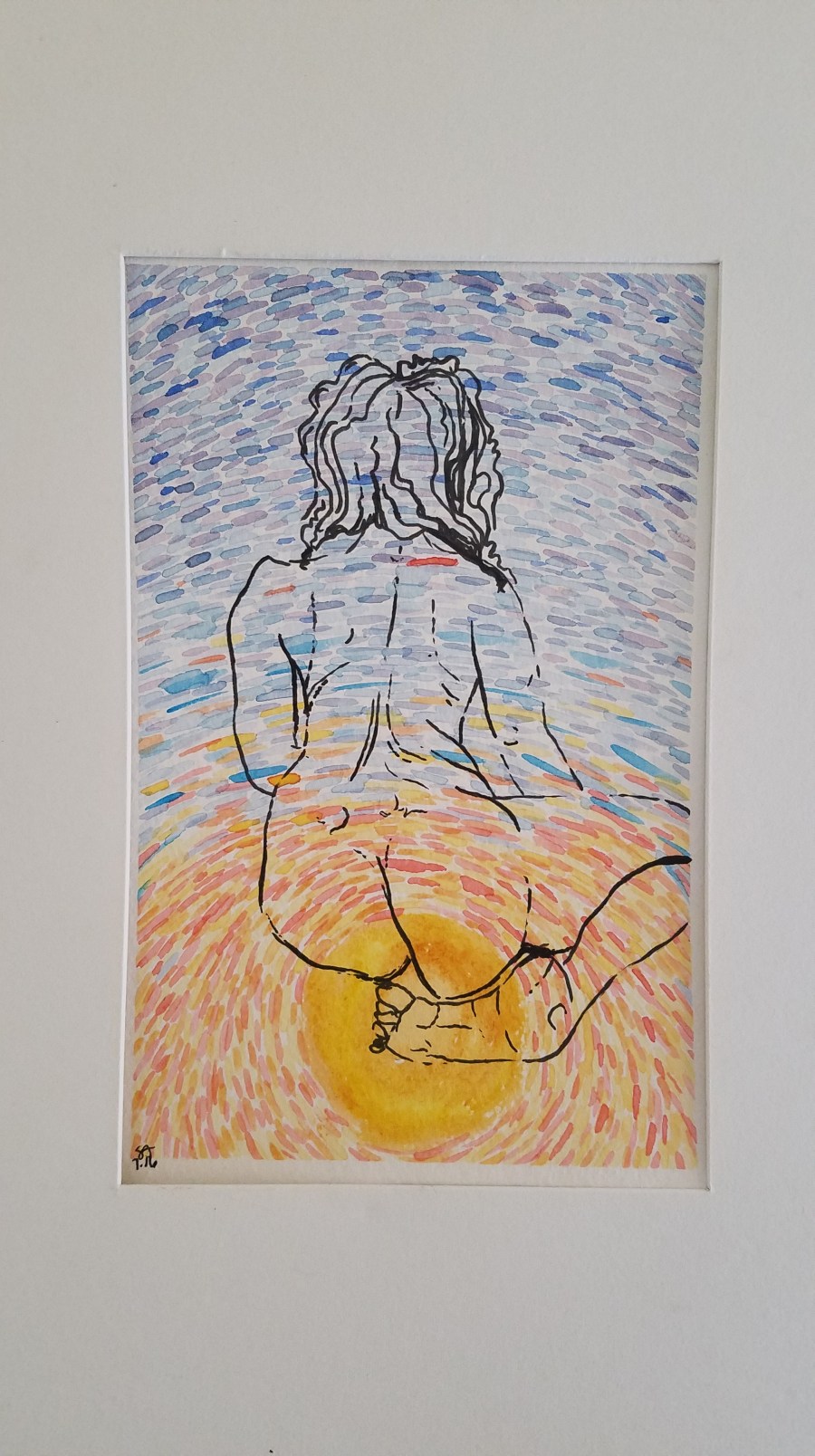
Weekly Write: “Body Talk” by Sara Brown

Body Talk

Days stretch like unruly vinca vine spilling out of upright, Bernardo red geranium baskets; we snip them with tough-handed scissors and Katie weaves them into crowns to place upon our heads, tiny limelight leaves cascading over our faces.

Nights are short as flats of youthful monoecious begonias sprouting, thick with moisture, heavy. I dream of unloading dust-bottomed trucks and wake myself in sleep as my arms support imaginary trays and pass empty air onto my spare pillow, rolling beads of sweat tucked behind my ears for the demand of a defeated body even sleep cannot stop.

The heat scoops out the mind, replaces it with rhizomes and rootstalks grasping at water. I see petals pressed to my eyelids. It is more than just labor I exchange for paper, it is the way I learn to breathe, reaching for water like flora, beginning to crave the burn of sunlight in any enclosed space.

I trade in smooth skin for dirt ingrained into each lined path of my fingerprint, collections of bruises I hold on my legs; the slopes of kneecaps, deep blue like that of fertilizer droplets onto sundried concrete.

Pushing hot metal loading carts of hanging Boston ferns, I rely on brass guitar hamstrings, twisted tight, and round back corners of greenhouse plastic to spill out with the backfield breeze tucking more water behind my ears. The peppers grow in the adjacent field, sun hats and beaten flannels hunch to pick lines. I count my steps and check at lunch, rubbing ice in paths across my calves.

My stomach dives a flip when I see the tapeners, a vine and plant tying tool, under the counter next to the sandwich bag of stale cigarettes. August, burning, I spent days propping up hungover shoots of blackberry plants, plump black fruit at the tips, clinging to stems. Hot blackberries melted on our tongues as we tried to keep count of the early crop, tried to coerce photosynthesis into biting its own tongue as we snipped off the white flower buds.

No one grabs my weight, assists my kneecaps when I collapse in iron-efficient orange dirt, my body pushing up dust into nostrils. Buckets for catching weeds thrown in the air sit at the wood line, good containers for vomiting out heat stroke. I heave the remnants into the flower graveyard back towards the edge of the property, where my DNA and failed, moldy bulbs of lilies meld together, hold a plot in the fertile soil where pansies sprout up each spring. The life always returns.

I walk at the end of October, retire my bones until the next planting season. In our language of the flower, the root, the bee, what can you say about a woman and her body that mine has not already said?

Sara Brown received her BA in literature with a concentration in creative writing from Stockton University in December 2018. I have had my photography published in Into the Void, Midwestern Gothic, Camas, and my poetry and creative nonfiction in Tiny Leaf, the Raw Art Review, Permafrost, and Toho Journal.


“Like”, “Share”, and comment on this poem to nominate it for the Annual Swimming with Elephants Publications 2020 Anthology.

Click here check out the 2019 Anthology:  Trumpet Call; a Swimming with Elephants Anthology available for only $12.95.

Weekly Write: “Blue” by Katie Karnehm-Esh

Blue

I think of the soft blue sweatsuit you were wearing that warm day in May. Then I think of the way you stared through the bars of the crib, and us. You must be a teenager by now; do you still sleep in a crib? I have a photo of you in my office that one of the students took—do you remember the boy with the red hair?—as I clipped your fingernails through the bars. I can’t look at it very often, and I am grateful that in this photo I cannot see your face. Sometimes my heart still twists up when I think of you, lying on your side staring into a dark tiled room, making occasional noises in neither English nor Mandarin.

Did you know I thought you were a boy the whole afternoon? Blame it on the bowl haircut or the blue sweatsuit. After two weeks in China, I should have known so many of you become androgynous in the orphanage. But I knew the gender of the tiny girl in pink who grinned and stole food. We brought snacks for all the children, and she grabbed the largest hoard. Everyone but you and the infants had a stash, curled their bodies around their plastic-wrapped food. Midway through washing our hands, the water stopped. The German nurse told us the director often turns off the water, that at mealtimes the workers put out food and let the children fend for themselves. Fewer diapers this way. We thought of this when they served us a private cafeteria feast. So much broccoli and pork. So many noodles choking in our throats. The German nurse said, “Eat. If you get upset. I can’t come back to help them.”

I picked you up to help you eat the smashed bananas. The nurses said you would choke and throw up if you ate; they said you only ate milk. I offered a spoonful, slow. Then another, praying it wouldn’t make you sick later.

After I picked you up, there was no reason to put you down. They told me later you were nine years old, but I could not believe you were more than five. You were stiff and quiet in my arms, sometimes seizing into fast shallow breaths. It’s OK, I would tell you, rocking back and forth. We swayed down the green-gray hallway, stopping in the bathroom where two children sat on the floor in a shower stall. One kept laughing and laughing as the water gurgled. The other sat as silent as you. “They protect each other,” one of the nurses told me. The tiny pink grinning girl ran up to me and demanded more snacks. When you started to hyperventilate again, I patted your back. Your spine was like the ridges of a rock wall.

When the German nurse told us we had twenty more minutes, and went back to checking vital signs and bruises, I stepped outside into the courtyard with you. You blinked; so much green and sun. The guard dog in the courtyard barked at us, asking who are you? We walked over to answer. He stared at us from behind a circular fence surrounding a tall tree, and you stared back at him, that furry black thing. Then you leaned your head on my shoulder and sighed.

Something inside me didn’t so much crack as give way. I looked at the white van we’d ridden in from Shenyang, and thought about our flight on Sunday, your crib in the big tiled room, the bananas the workers said you couldn’t eat. If I made a run for the van with you, the German nurse could never come back to feed you.

When she said it was time to go, she didn’t seem angry that it took me a long time to walk you back to your crib and lay you down. You stared out into the room, like you had when I found you. I don’t know what I said. Maybe nothing. I speak English after all. This was not the right place to say I love you or I’ll come back because maybe lying is worse than never having been here. So I whispered goodbye; it’s OK; goodbye; it’s OK while I put you back in your bed and walked away.

Did you know that for months afterwards, I sent emails to check on you? I asked as casually as I could, in a way that someone who is voluntarily childless and in a bad marriage will ask after a child thousands of miles away in an orphanage that does not give up children or feed them. You would never be coming home with me. So when I prayed, it was that you had food. That you had green afternoons and sunshine and a dog barking hello! And that sometimes, when someone rubbed your back and clipped your fingernails and told you it was OK, this would feel like a happy, reoccurring dream you couldn’t quite place.


Katie Karnehm-Esh’s background is in creative nonfiction and poetry, with a Ph.D in creative writing from the University of St Andrews, Scotland. Her writing has been published in Whale Road Review, Barren Magazine, The Cresset, The Other Journal, and Windhover. Additionally, she writes a monthly blog for Annesley Writers Forum. Her writing often centers around holistic health, travel, and faith as well as social justice, and she welcomes the opportunity to learn from fellow writers.


“Like”, “Share”, and comment on this poem to nominate it for the Annual Swimming with Elephants Publications 2019 Anthology.

Click here check out Parade: Swimming with Elephants Publications Anthology 2018 available for only $10.95.

Happy Birthday by Sarah Allred

Happy Birthday

It didn’t take my mother long to comment on how quiet I am, today.

“Awfully quiet, Sar.”

“I’m a pretty quiet person,” I replied, as mildly as I could. Sometimes I am surprised she hasn’t noticed this yet, or assimilated it into her understanding of who I am as a person, in the twenty-seven years we’ve known each other.

I refocused on getting ready for our hike, making sure I had water, stretching my hips.

We started out and it was a lovely day for hiking. My mother kept plowing of onto side paths, wrong ways, and I had to redirect her a few times before I decided to walk a few paces ahead of her and my father. My me about some plants he saw on the trail that were also at the stable where they keep their horses.

“That’s fennel,” I said. “It grows wild around here, and it’s edible.” I pointed out a couple more plants I knew, an invasive species, castorbean, that was abundant in the area, before I went back to walking quietly ahead. My mother kept up a steady chatter behind me, telling the lizards how much she loved them and yelling at the truck doing construction a few hills away, across the highway.

“Get outta here, you trucks, you’re blocking my view of nature!” A Chicago native turned Californian. She was also very upset by the presence of a water drainage pipe, a property boundary sign, and some telephone cables.

We stopped to take pictures at least three times on the way up, and at about eighty percent of the way there was a lone wind cave where we stopped to rest and, of course, take more pictures. I took some of my parents, watching their dynamic through the lens. My father stoic, a trouper, as mom grabbed his hand four photos in and wrestled him gently into a more affectionate pose for photos five through eight. I even got him to smile for the last one.

My turn came; Dad and I switched places. I leaned next to Mom on the low oak branch and smiled at my dad and the camera.

“Look Gav, Sarah’s in one of her ‘I don’t like to be touched’ moods,” my mother announced as she proprietarily threw her arm over my shoulder, pulled me in and put her other hand on my closer shoulder. I allowed it, it was her birthday, and what did it cost me? I could let go of somethings and be nice, on her birthday. And then I thought we were done, I made a move to get up, but she stopped me, put her arm further up my neck and used her palm to turn my cheek so that I was facing her.

“I want to take one like this, with us looking right at each other.”

I looked her in the eyes a moment, light green, ringed in makeup. I’m sure I pulled back from the thought before I made a conscious decision.

“No, this is too much,” I said. I got up and flapped my hands at her, like that might lessen the blow. “You’re making me uncomfortable.”

She gave a heavy sigh. “Can’t say I didn’t try,” as if that was something people accuse her of often.

Say you didn’t try what, I wondered. Didn’t try to make your daughter take an awkwardly staged photo? Didn’t decide to violate someone’s boundaries even though you made it clear you were aware of them?

“All right,” I said, clapping my hands together. “Are you guys ready to go to the top?”

“Let’s just go back,” my mom said, smoking her e-cigarette and facing away from us, to the mountains.

“What?” my Dad.

“Let’s just go back. I’m good.” She repeated.

“Well,” I said, “We’re really close. Like ten minutes from the top. I’d really like to go all the way up.”

“Okay, fine. I’ll wait here.” She puffed away, still not looking at us.

“I feel like you’re being passive-aggressive,” I ventured, slightly terrified of a mountain-side blowout and the subsequent silent hike down to the car where I would be both irritated and terrified that my mother would stumble in her anger and roll off a cliff.

“No, I’ll wait here, I’m fine.” she said again.

My dad and I mentally shrugged at each other and mosied up to the top, chatting about the best path, indigenous plants, my recent trip to the Grand Canyon with a boyfriend of whom I am unsure of their approval. It was pleasant, the view was lovely, I was satisfied with the completion of the hike.

We found our way back to Mom who was sitting on a rock, blowing bubbles. She apparently always has them in her purse. Most people don’t leave the house without their keys, cellphone; my mother: bubbles.

“How was it?” She is still not looking at us.

“Pretty cool.” My father is perennially nonchalant. “Really nice view.”

“Blow some bubbles.” She hands the tube and wand to Dad.

“I’m good for now, maybe later.”

“They make you happy.”

“I’m already happy,” he says, but he blows the bubbles. Makes some jokes about them causing airplane accidents. I marvel at his patience.

We make our way back to the car, pretty uneventfully, and make our way to the beach twenty minutes away where we have planned to picnic.

We get there and it is gorgeous. I jump in the ocean before I grab a chicken leg and eat with my parents.

“I can’t believe I didn’t bring a swimsuit!” Mom exclaims.

“Go naked,” Dad says. He still has his boots on.

“I have leggings on, and a sports bra.”

“I’ve gone in in a sports bra before,” I shrugged. I am smoking at a remove now, so as not to affront my parents who have been off cigarettes for a year. Graciously neither of them comments on my bad habit.

My mother says, “Is that a dare?” She is already stripping off clothes.

I said, “No, I’m just saying it can be done. I’ll join you in a minute.”

She runs in, screaming at the cold and flailing in the shallows. I walk in after her, past the breakers, and I glide around, doing my water dance, letting the ocean buoy and cradle me. I am chilly but at peace, I watch the water ripple through my fingers. This is the happiest I’ve been all day, and I am glad my mother is in the ocean with me. I look back at her.

She is still thrashing in the break line, yelping, plowing her body into the waves. She is smacking at the water as if she can beat it down. She reminds me of a child, specifically a boy child, aggressive for no discernable reason. “These waves are attacking me!” She yells.

And suddenly I realize, this is how it is for her. In her eyes, she is always under attack, she always has to fight, and if there isn’t anything to attack she must create it. Maybe she can’t feel strong on her own, there must always be an oppressor, she is the underdog, the caboose.

And I wonder why she bothers me so much, with that victim mentality; her fibromyalgia, her little toe that moves separate of her cognitive command, the way she views cancer as an evil force reaping strong, sweet people from her life, that time she had lupus, her restless leg syndrome, her recent diagnosis of bipolar disorder and subsequent bout of mood-stabilizing drugs that did everything but and in her words, ‘were going to kill her’.

How can I be so irritated by someone who has been diagnosed with mental illness. Shouldn’t I, as much as anyone who has struggled with depression, be more loving and compassionate? Or is this just the way of it with mothers and daughters, with parents and their children? Is it one of those things I won’t understand until she is dead and buried?

I don’t know when I will know.